
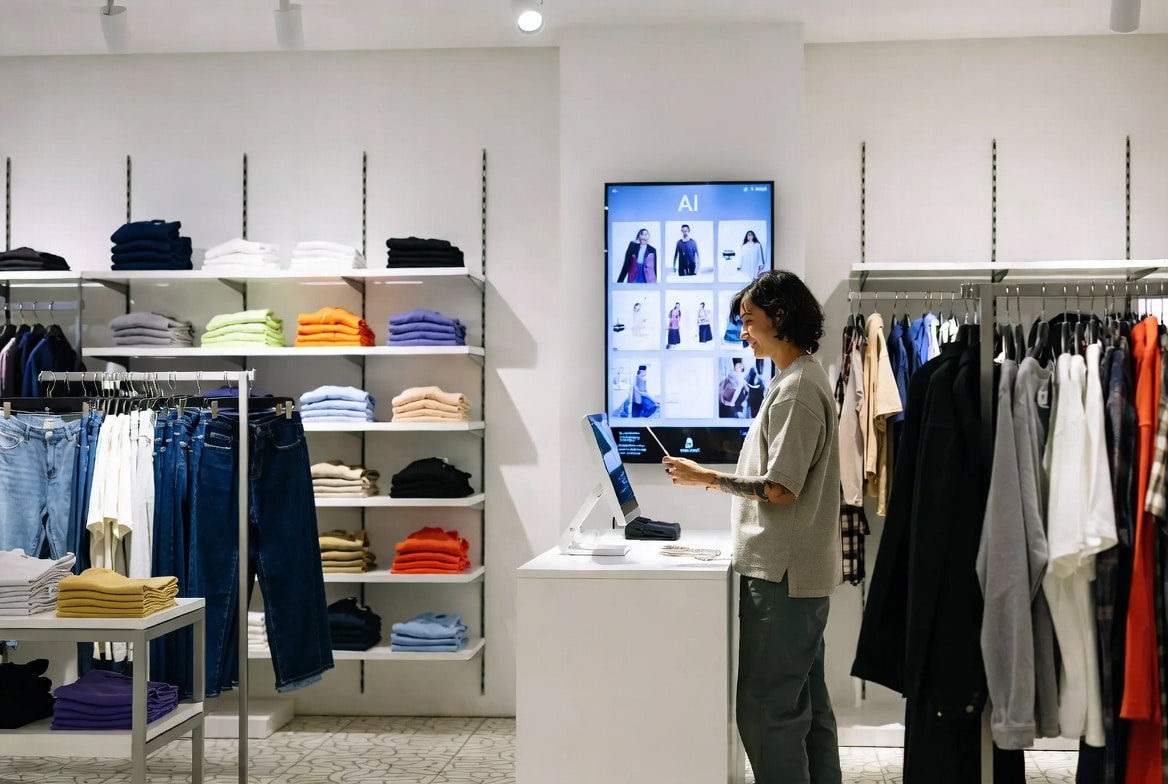
Artificial intelligence is no longer only something retailers discuss in innovation meetings. It is already starting to reshape how retail teams forecast demand, manage inventory, support merchandising decisions, optimize labor, and respond to changing customer expectations.
But for mid-market retailers, the real challenge is not deciding whether AI matters. It is knowing where to begin, how to prove value, and how to turn AI-driven insight into everyday execution.
That was the focus of the webinar From Experimentation to Impact: How Mid-Market Retailers Are Winning with AI. The discussion explored how retailers can move beyond isolated pilots and start applying AI in ways that improve decision-making, operational agility, and measurable performance.
The conversation also connected directly to FarSightIQ, Jesta I.S.’s AI-powered retail intelligence platform, and the role of practical AI modules in helping retailers move from prediction to action.
For mid-market retailers, this is especially important. These organizations face many of the same pressures as larger enterprises, including demand volatility, inventory imbalance, margin pressure, supply chain disruption, labor constraints, and rising customer expectations. However, they often have leaner teams, tighter budgets, and less room for long experiments that do not quickly translate into measurable value.
AI adoption does not have to begin with a massive transformation program. It can begin with one focused business problem, one useful dataset, and one clear path from insight to impact.
For a deeper discussion of the frameworks and examples covered in the webinar, visit the full page for From Experimentation to Impact: How Mid-Market Retailers Are Winning With AI.
Why AI Pilots Often Fail to Scale
Many AI initiatives begin with excitement around the technology itself. Teams test tools, explore broad possibilities, and launch pilots to understand what AI can do. While experimentation can be useful, it often stalls when the project is not connected to a specific business outcome.
This is where retailers can fall into the pilot trap. A pilot may produce interesting findings, but if it does not solve a real operational problem, influence a business decision, or fit into an existing workflow, it becomes difficult to scale. The organization may learn something, but the business does not necessarily change.
For mid-market retailers, that is a costly risk. Time, budget, and internal attention are limited. AI projects need to be practical from the start.
Before starting an AI initiative, retailers should ask:
- What business problem are we trying to solve?
- Which decision do we want to improve?
- What data do we need to support that decision?
- Who will use the output?
- How will success be measured?
- How will the insight connect back into the systems and workflows teams already use?
When retailers start with these questions, AI becomes less abstract. It becomes a practical tool for improving execution across merchandising, inventory, planning, supply chain, store operations, and customer experience.
Where AI Can Create Practical Retail Value
The webinar highlighted several areas where AI can create meaningful value without requiring retailers to reinvent their business from day one.
Smarter Demand Forecasting
Demand forecasting is one of the clearest starting points for AI in retail. Forecast accuracy influences purchasing, allocation, replenishment, markdowns, store execution, and customer satisfaction.
When forecasts are inaccurate, retailers feel the impact quickly. Excess inventory ties up working capital and increases markdown risk. Too little inventory leads to missed sales, frustrated customers, and poor store performance.
AI can help retailers analyze patterns across sales history, seasonality, product performance, promotions, store behavior, and other demand signals. This is where solutions such as forecastIQ can support more accurate pre-season and in-season forecasting, helping teams make stronger buying, allocation, and replenishment decisions.
For mid-market retailers, even small improvements in forecast accuracy can make a meaningful difference. Better forecasting helps teams buy with more confidence, allocate inventory more effectively, and respond faster when demand shifts.
Earlier Visibility into Purchase Order and Replenishment Risk
AI can also support purchase order and replenishment management by helping retailers identify risk earlier. Instead of waiting until delays, stockouts, or inventory gaps create problems downstream, AI can help flag issues before they affect store availability or customer orders.
This matters because purchase order execution touches multiple teams and timelines. Vendors, warehouses, merchants, planners, stores, and customers all depend on accurate inventory visibility and timely follow-up.
For retailers trying to keep products available while limiting excess stock, replenishIQ can help convert demand signals into replenishment and inventory recommendations. This makes it easier for teams to prioritize follow-up, manage reorder needs, and reduce the risk of avoidable stockouts or overstocks.
More Effective Labor Planning
Labor is one of the most important areas of retail execution. Stores need enough coverage to serve customers, receive inventory, execute fulfillment tasks, and support daily operations. At the same time, overstaffing increases costs.
AI can help retailers better align labor with expected demand, store traffic, order volume, promotions, and workload. The goal is not simply to reduce labor. The goal is to use labor more intelligently.
For mid-market retailers, better labor planning can improve both profitability and customer experience by helping stores prepare for peak periods, seasonal changes, fulfillment demand, and operational workload.
Smarter Order Routing and Customer Experience
AI can also improve how retailers fulfill customer orders. In an omnichannel environment, retailers often need to decide whether an order should ship from a warehouse, a store, or another location.
That decision affects speed, cost, inventory availability, and customer satisfaction. AI can support smarter order routing by considering factors such as location, inventory position, fulfillment cost, delivery expectations, and operational capacity.
AI can also help retailers understand customer service trends. By analyzing support tickets, order issues, product complaints, and return reasons, teams can identify recurring problems and act before they become larger business issues.
Returns prediction is another valuable use case. AI can help uncover patterns related to sizing, product descriptions, images, quality, or fulfillment accuracy. With better insight, retailers can address root causes instead of simply processing returns after the fact.
Faster Answers for Internal Teams
Some of the most practical AI opportunities are internal. Retail teams often spend significant time searching for information, building reports, checking spreadsheets, and pulling data from multiple systems.
AI can help reduce that manual work by giving teams faster access to answers and insights. Merchants can identify underperforming products faster. Planners can spot inventory imbalances earlier. Analysts can spend less time preparing reports and more time interpreting results.
This is where AI can be especially powerful. It does not replace retail expertise. It gives teams more time to apply that expertise.
The AI Readiness Foundation
AI cannot deliver reliable value without the right foundation. Retailers need to understand what must be in place before AI can scale across the business.
The first requirement is data. AI depends on usable, relevant, and trustworthy data. However, retailers do not need to fix every data issue across the business before starting. A better approach is to begin with a focused dataset that supports one specific use case.
For example, a retailer might start with one product category, one region, one group of stores, or one forecasting challenge. This makes the project more manageable and easier to measure.
The second requirement is strategy. AI should be connected to a clear business objective. A broad goal like using AI for inventory is difficult to execute. A focused goal like improving forecast accuracy for a high-volume category to reduce stockouts and markdowns is much more actionable.
The third requirement is technology. AI insights need to connect to the systems where retail decisions are made. If a recommendation stays outside the merchandising, inventory, replenishment, store operations, or reporting workflow, its impact will be limited.
The fourth requirement is people. AI adoption depends on trust. Retail teams need to understand how AI supports their work, how recommendations are created, and where human judgment remains essential.
The fifth requirement is governance. As AI becomes more embedded in retail operations, organizations need clear guardrails around data security, decision rights, accountability, and responsible use. Governance does not slow AI down. It makes AI safer, more trusted, and easier to scale.
Start with the Discovery Loop
One of the most useful ideas from the webinar was the Discovery Loop. Before retailers build a broad AI program, they should focus on the connection between the business problem and the data needed to solve it. This helps prevent teams from launching broad AI initiatives without enough clarity.
The Discovery Loop starts with a business question: what problem matters most right now? It then moves to the data question: what information do we need to test this use case? From there, retailers define the outcome: what would prove that this project created value? Finally, teams consider execution: how would the insight be used in a real workflow?
This approach helps retailers avoid trying to solve everything at once. It also helps them choose first projects that are realistic, measurable, and valuable.
For a mid-market retailer, the best first AI project is not necessarily the most impressive. It is the one that solves a real problem, uses accessible data, and creates a clear reason to continue investing.
AI Value Depends on Execution
AI value does not come from insight alone. It comes from what teams can do with that insight.
A forecast only matters if it improves purchasing, allocation, replenishment, or markdown decisions. A risk alert only matters if teams can act before the issue becomes expensive. A recommendation only matters if it fits into the way retail teams already work.
That is why connected retail systems are so important. Retailers need AI to work with merchandising, inventory, product, store, pricing, order, vendor, and sales data. Within the FarSightIQ ecosystem, modules such as forecastIQ, replenishIQ, and optimizeIQ are designed around this same principle: turning retail data into recommendations that support real operational decisions.
For example, optimizeIQ can support inventory balancing by analyzing projected demand against current inventory levels and surfacing transfer or allocation recommendations. This is the kind of connection that helps AI move from a dashboard insight to a decision that affects stores, fulfillment, and margin.
For mid-market retailers, this connection is critical. Teams do not need more disconnected dashboards. They need better decisions inside the systems and processes they already rely on.
AI Should Amplify Retail Teams
AI can create understandable concern inside organizations, especially when teams are unsure how it will affect their roles. That concern is natural.
However, the most practical use of AI in retail is not to remove people from the process. It is to help people work better.
AI can reduce repetitive analysis, surface issues faster, summarize performance, recommend next steps, and help teams focus their time where judgment matters most.
A merchant still understands the customer, the brand, the assortment, and the commercial context. A planner still understands trade-offs, timing, and business priorities. A store operations team still understands what is realistic on the ground.
AI can support these teams by giving them faster visibility and better decision support. In that sense, AI should be viewed as an amplifier. It helps retail professionals spend less time searching for information and more time acting on it.
A Practical Starting Point for Mid-Market Retailers
For mid-market retailers, the path to AI impact can start with a simple roadmap:
- Choose one high-value operational problem, such as demand forecasting, purchase order risk, inventory imbalance, labor planning, order routing, or return analysis.
- Define the business outcome, such as reducing stockouts, improving forecast accuracy, lowering markdown exposure, speeding up purchase order follow-up, or improving fulfillment efficiency.
- Identify the data needed for that specific use case instead of trying to clean and restructure the entire business before proving value.
- Connect the insight to a real workflow so the AI output supports a decision made by a real team.
- Measure the impact by evaluating whether the project improved a process, reduced risk, saved time, improved accuracy, or supported better execution.
- Scale responsibly once the organization has proven value and has stronger internal support, clearer governance, and a better understanding of what works.
This is also where the right technology partner matters. Mid-market retailers do not need to start with a blank page. They can begin by identifying where AI can support the decisions their teams already make and then connect those insights to practical retail execution.
The Bottom Line
AI is no longer only for the largest retailers with the biggest technology budgets. Mid-market retailers can also use AI to improve forecasting, inventory management, labor planning, order execution, customer experience, and internal decision-making.
But success depends on focus. Retailers do not win with AI by experimenting endlessly. They win by choosing practical use cases, connecting them to business outcomes, preparing the right data, supporting their teams, and making sure insights can turn into action.
The opportunity is not just to test AI. The opportunity is to use AI to make retail operations smarter, faster, and more resilient.
For mid-market retailers, the best place to start is not a massive transformation. It is one meaningful problem, one focused pilot, and one clear path from experimentation to impact.
Not sure where to start on your own AI journey? Explore the full webinar page for From Experimentation to Impact: How Mid-Market Retailers Are Winning With AI, then get in touch with our team. We can help you identify the right use case, assess the data foundation, and build a practical path from experimentation to measurable impact.
