
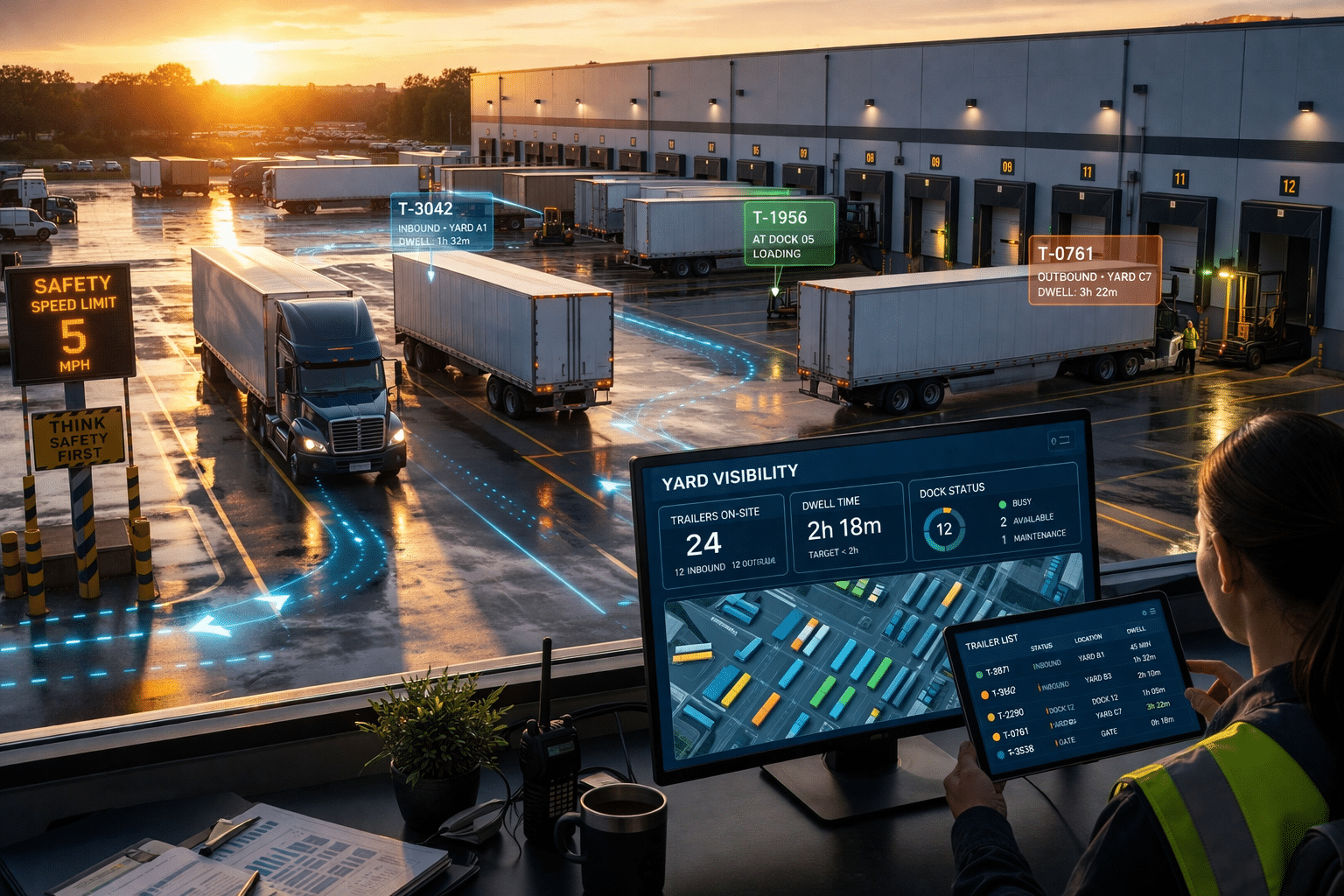
Warehouse performance is often measured by what happens inside the four walls. Teams focus on receiving speed, order accuracy, labor productivity, picking efficiency, replenishment, and shipping performance. But many of the delays that hurt those metrics begin before inventory ever reaches a storage location or a dock door. They begin in the yard.
For many operations, the yard remains a blind spot. Trailers arrive, drivers check in, equipment is parked, loads wait for assignment, and yard moves happen throughout the day, yet visibility into that activity is often limited. Teams may rely on paper logs, spreadsheets, radio calls, disconnected systems, or verbal updates to understand what is on site and what needs to move next. As a result, trailers sit longer than they should, doors are not always assigned at the right time, labor planning becomes reactive, and dwell time grows.
That is why in-yard visibility matters. The ability to see what is in the yard, where it is located, what status it is in, and how long it has been waiting can have a direct impact on warehouse flow. When that visibility is connected to warehouse execution, the operation gains a more complete view from gate to dock. Instead of treating the yard as a separate area outside warehouse control, businesses can use WMS-connected processes and real-time data to manage the yard as an active part of material flow.
Reducing dwell time is one of the clearest benefits of this approach. When teams know which trailers have arrived, which are loaded or empty, which are inbound or outbound, which are ready for a door, and which have been sitting too long, they can act faster and with greater confidence. That means fewer delays, less congestion, better trailer turns, and stronger coordination between transportation, yard, and warehouse teams.
Why the Yard Has Become a Critical Performance Zone
In many facilities, the yard is still viewed as a staging area rather than a strategic operational zone. That mindset creates problems because the yard is not passive space. It is the transition point between transportation and warehouse execution. Every inbound and outbound move depends on what happens there. If the wrong trailer sits too long, a receiving team may not get the inventory it needs on time. If the correct outbound trailer is not staged properly, shipping can fall behind. If dock doors are assigned without accurate yard status, labor and equipment may be underused or misaligned.
As supply chains become faster and more time-sensitive, these gaps become more expensive. Appointment schedules are tighter. Carrier expectations are higher. Warehouse labor must be used more efficiently. Managers need more predictability, not less. In that environment, a lack of yard visibility affects much more than trailer location. It affects dock scheduling, workforce planning, detention costs, throughput, and customer service.
This is where in-yard visibility changes the picture. Real-time awareness of trailer presence, trailer location, status changes, movement history, and dwell time gives operations a clearer operational foundation. It reduces the number of decisions made by assumption and increases the number made with current, usable data. That makes the yard easier to manage and the warehouse easier to run.
What In-Yard Visibility Actually Means
In-yard visibility is more than simply knowing whether a trailer has arrived on site. A stronger visibility model answers a broader set of operational questions. Which trailers are currently in the yard? Which are inbound and which are outbound? Which are empty, loaded, sealed, available, or awaiting instruction? Where exactly is each unit parked? Which trailers are assigned to a specific dock or move queue? How long has each trailer been waiting? Which loads are urgent? Which should move next?
When operations cannot answer these questions quickly, dwell time rises because movement becomes reactive. Teams spend time hunting for equipment, confirming status manually, or coordinating moves through phone calls and memory. Even when the information exists somewhere, it may not be current, centralized, or visible to the people who need it most.
True in-yard visibility creates a live view of the yard as part of a connected workflow. It helps warehouse and yard teams move from “I think that trailer is here” to “I know where it is, what it contains, how long it has waited, and whether it should go to door 12 right now.” That difference is operationally significant because speed depends on certainty.
The Connection Between WMS and Yard Visibility
A warehouse management system is designed to control and optimize warehouse execution. It manages activities such as receiving, putaway, inventory movements, replenishment, picking, packing, and shipping. But warehouse execution does not begin only when product crosses the threshold of the building. In practice, many key decisions are already being shaped in the yard.
That is why WMS in-yard visibility is so valuable. When the WMS has accurate information about trailer arrivals, yard status, and dock readiness, warehouse teams can align receiving and shipping activities more effectively. Labor can be scheduled based on actual trailer presence, not estimated arrival times alone. Receiving priorities can reflect what is truly on site. Outbound teams can verify whether the right trailer is staged and ready before loading windows are missed. Managers can identify stalled trailers before they turn into service failures or detention issues.
This does not necessarily mean that the WMS alone manages every yard function. In some operations, a dedicated yard management system handles yard-specific workflows while integrating with the WMS. In others, the WMS may extend enough visibility into the yard to improve execution even without full YMS functionality. What matters most is that the handoff from gate to dock is no longer treated as invisible or disconnected.
How Poor Yard Visibility Increases Dwell Time
Dwell time is rarely caused by one major failure. More often, it builds through small delays repeated across the day. A driver arrives and waits at the gate. Check-in takes longer than expected. The trailer is parked, but its location is not updated clearly. The warehouse is not ready because the receiving team did not know the load had arrived. A dock door remains occupied longer than planned. Yard drivers are busy with less urgent moves because the operation has no clear priority sequence. A trailer that should have moved first stays parked while people confirm status manually.
Each of those delays may seem minor on its own, but together they slow the entire operation. Inbound freight reaches the dock later. Outbound loads wait longer to be staged. Dock schedules become harder to trust. Labor is forced into catch-up mode. Carrier wait times rise. Detention charges become more likely. Service levels suffer.
This is why yard visibility is directly tied to dwell reduction. Visibility allows teams to act sooner, assign smarter, and move with intention. It shortens the time between arrival and action. It reduces the time spent searching, confirming, and reacting. Instead of discovering problems after delays have already happened, managers can see conditions developing in real time and intervene earlier.
Real-Time Visibility Creates Faster Trailer Flow
When in-yard visibility improves, the trailer journey becomes more controlled from start to finish. Arrival is recorded more quickly. Trailer location is captured and visible to the right teams. Status changes are updated as the trailer moves through the yard. Dock assignments can reflect actual conditions rather than assumptions. Yard jockeys and move teams can prioritize tasks based on urgency, appointment timing, or warehouse need. That creates a more continuous flow between transportation arrival and warehouse execution.
This flow matters because the yard is not only a place where trailers wait. It is a place where timing decisions are made. If the right trailer reaches the right door at the right time, receiving and shipping performance improve naturally. If that sequence breaks down, delays cascade into multiple functions.
Real-time yard visibility also gives operations stronger control over exceptions. Teams can see which trailers have exceeded expected dwell thresholds, which arrivals are at risk of missing windows, and which moves are still pending. That makes escalation faster and helps managers focus attention where it will have the biggest impact.
Better Yard Awareness Improves Dock Utilization
Dock doors are among the most valuable operational assets in a warehouse. When they are used poorly, throughput suffers. A common problem is that dock decisions are made without a reliable view of the yard. Teams may know what should be arriving, but not what has actually arrived. They may have a schedule, but not current status. As a result, some doors are left waiting for trailers that are not ready, while others could have been used more productively.
In-yard visibility improves dock utilization by giving managers and floor teams a more accurate picture of what is available now. If a trailer is already checked in and parked nearby, the door can be assigned sooner. If another load is delayed at the gate, the operation can adjust rather than holding a door open unnecessarily. If an outbound trailer is staged and ready, loading can begin without extra coordination time.
That kind of visibility leads to smoother dock flow and more dependable execution. Over time, it also improves planning because teams can compare scheduled activity with actual trailer movement and identify where timing gaps tend to occur.
The Labor Impact of Yard Blind Spots
One of the biggest hidden costs of poor yard visibility is wasted labor. Employees spend time locating trailers, verifying status, making calls, chasing updates, and resolving preventable confusion. Yard drivers may move trailers in the wrong sequence simply because the priority is unclear. Receiving teams may be ready for one load while another sits idle nearby. Supervisors lose time managing exceptions manually instead of improving the process.
With better in-yard visibility, labor becomes more targeted and productive. Yard teams know which moves matter most. Warehouse staff are informed about real arrivals and can prepare accordingly. Supervisors can focus on managing flow rather than searching for information. Even small gains in this area can add up quickly because the benefits repeat across shifts, doors, trailers, and daily volume.
This is especially important in environments where labor is tight and every minute of productive time matters. Reducing unnecessary motion and communication delays can be just as valuable as improving physical movement itself.
The Role of Data in Managing Dwell Time
Dwell time reduction does not come only from seeing what is happening right now. It also comes from understanding patterns over time. When trailer activity is visible and recorded consistently, managers can analyze where delays happen most often. They can compare dwell by carrier, shift, trailer type, lane, load type, or dock area. They can identify repeat bottlenecks at the gate, in trailer assignment, in dock availability, or in move execution.
That information makes process improvement more precise. Instead of assuming the yard is slow in general, managers can pinpoint whether the problem is appointment clustering, poor dock coordination, inconsistent check-in procedures, lack of move prioritization, or insufficient communication between the yard and receiving teams.
This is one of the most valuable aspects of connected yard visibility. It supports both immediate action and longer-term improvement. Teams get a live operational view, but leadership also gets performance insight that can guide staffing, scheduling, technology decisions, and continuous improvement efforts.
Technologies That Support In-Yard Visibility
Operations use a range of technologies to improve yard visibility, depending on scale, budget, and complexity. These may include barcode scanning, RFID, GPS, mobile devices, license plate recognition, gate kiosks, sensors, telematics, and real-time tracking tools. Some environments also use automated alerts, geofencing, or computer vision to detect location and movement more accurately.
The technology itself is only part of the value. What matters most is how that data is turned into operational visibility. A system that captures yard status but does not make it usable across warehouse and transportation workflows will not deliver the full benefit. The real goal is to ensure that current yard information supports faster, better decisions.
When that happens, the warehouse gains more than location data. It gains timing, context, and control. It knows not just what is present, but what should happen next.
Common Signs Your Yard Needs Better Visibility
Many organizations do not realize how much dwell time is being created in the yard until the symptoms become routine. Drivers wait too long to check in. Teams lose time trying to locate trailers. Dock assignments are constantly adjusted at the last minute. The warehouse is surprised by loads that should have been expected. Yard moves feel reactive rather than planned. Managers hear frequent complaints about congestion, delays, and carrier waiting time. Detention costs appear repeatedly, but the root cause is hard to isolate.
These are usually signs of a visibility problem, not just a staffing or scheduling problem. If the operation cannot see the yard clearly, it cannot manage the yard proactively. And if it cannot manage the yard proactively, dwell time becomes harder to control.
Improving in-yard visibility helps replace uncertainty with real operational awareness. That change may begin with better status tracking, stronger WMS integration, clearer yard workflows, or more consistent gate and trailer data. But however it starts, the goal is the same: reduce wasted time between arrival and action.
Why This Matters for Modern Warehouse Operations
The pressure on warehouses continues to rise. Operations are expected to move faster, use labor more efficiently, coordinate more closely with transportation, and deliver better service without adding unnecessary cost. In that environment, the yard can no longer remain a low-visibility area managed by workarounds.
What happens in the yard shapes what happens at the dock, in receiving, in outbound staging, and across the broader warehouse schedule. A trailer that waits too long affects more than transportation. It affects inventory availability, dock productivity, carrier performance, labor utilization, and overall throughput. That is why the question “What’s in the yard?” is more important than it seems. It is really a question about control, readiness, and execution.
Using WMS-connected in-yard visibility helps answer that question with real data instead of assumption. It helps teams understand what is on site, what status it is in, what needs to move next, and where delays are building. Once that visibility exists, dwell time is no longer just something operations react to after the fact. It becomes something they can actively reduce.
Conclusion
The yard is not just overflow space outside the warehouse. It is a critical part of operational flow, and when it is not visible, the entire warehouse feels the impact. Longer dwell times, missed dock opportunities, wasted labor, detention exposure, and reactive decision-making often trace back to the same root issue: teams cannot clearly see what is happening in the yard in real time.
Improving in-yard visibility changes that. By connecting trailer status, location, timing, and movement to warehouse execution, operations gain a stronger handoff from gate to dock. They reduce search time, improve prioritization, make better use of labor and doors, and create a smoother path for inbound and outbound freight. Whether enabled through WMS-connected workflows, integrated yard tools, or broader real-time tracking capabilities, in-yard visibility helps warehouses move from guesswork to coordinated execution.
For organizations trying to reduce dwell time, improve flow, and strengthen overall operational control, one of the most valuable steps may be surprisingly simple: get a clearer view of what is in the yard and act on that visibility faster.
Common Questions
What is in-yard visibility in a warehouse environment?
In-yard visibility is the ability to track trailers, trucks, containers, equipment, and their operational status while they are on site in the yard. It helps teams know what has arrived, where it is parked, how long it has been waiting, whether it is inbound or outbound, and what action should happen next. This visibility supports better coordination between the gate, the yard, the dock, and the warehouse itself.
How does in-yard visibility help reduce dwell time?
It reduces dwell time by shortening the delay between arrival and action. When teams can quickly identify trailer location, status, priority, and dock readiness, they spend less time searching, confirming, and reacting. That helps move trailers through the yard faster and reduces unnecessary waiting at the gate, in parking areas, and at the dock.
Can a WMS improve yard visibility?
Yes. A WMS can improve yard visibility when it is connected to accurate yard status data and used to support better decisions around arrivals, receiving, dock assignments, and outbound readiness. Some facilities extend WMS processes into the yard, while others integrate the WMS with a dedicated yard management platform for deeper control.
What are the main causes of excessive trailer dwell time?
Excessive dwell time is often caused by slow gate check-in, unclear trailer location, delayed dock assignment, poor move prioritization, disconnected communication between yard and warehouse teams, and a lack of real-time operational visibility. In many cases, multiple small delays combine to create larger performance problems.
